The Innovation Project is the framework of educational autonomy (art. 11 of DPR 275/99) that allows the school to depart from ordinary timetables and rules. Authorized in successive five-year cycles (Ministerial Decrees of 2011, 2016 and 2021), it now enters its fourth cycle: 2026–2031.
It exists because the Cremona violin-making school is unlike any other Italian institute. It must give a highly specialized, internationally recognized training to an extremely mixed body of students — adults and teenagers, Italians and foreigners — while keeping alive a craft recognized by UNESCO.
The project defines a flexible, personalized, workshop-centered model, and strengthens the school's role at the heart of the most important centre of violin making in the world.
An atypical
student body.
A single classroom holds teenagers fulfilling compulsory education and adults who already hold a diploma or a degree, coming from every continent. Their prior education, language and expectations are wildly different — a standard, one-size-fits-all curriculum would simply exclude most of them. This diversity is exactly what the Innovation Project is built to serve.
Four goals.
Continuity
Continue redefining the Liuteria section in continuity with the earlier cycles, consolidating the excellence for which the school is recognized.
Maker & musician
Integrate violin making with the Music High School, reuniting — as in the past — the training of the musician and of the instrument maker.
A reference for the craft
Formalize the Institute's role in advanced technical and cultural training for the professional violin-making sector, one of the world's leading centres of production.
A new model
Pursue a new organizational and didactic model of quality, serving Italian artistic craftsmanship and the Made in Italy around the world.
Four pillars.
Living heritage · UNESCO
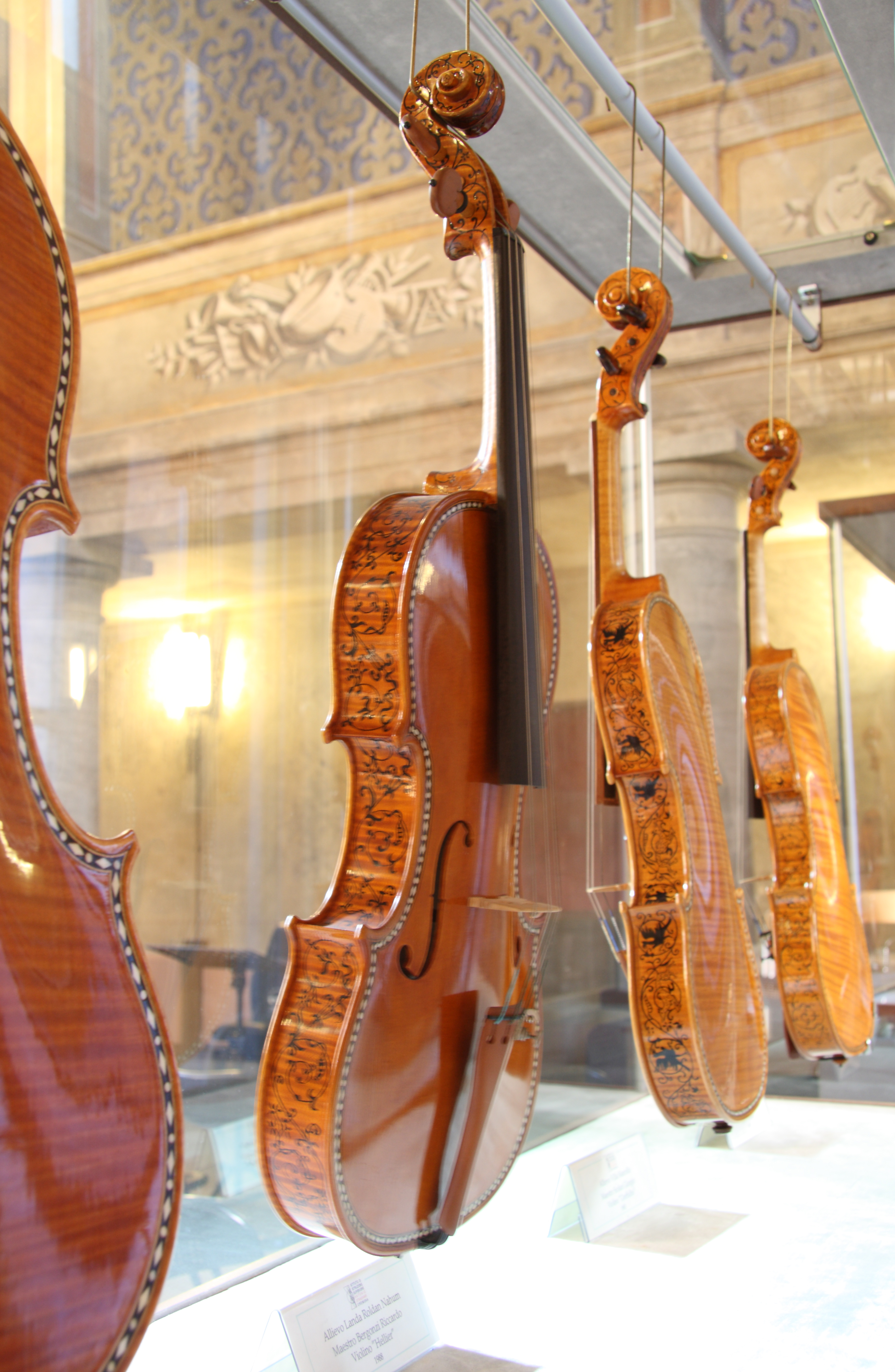
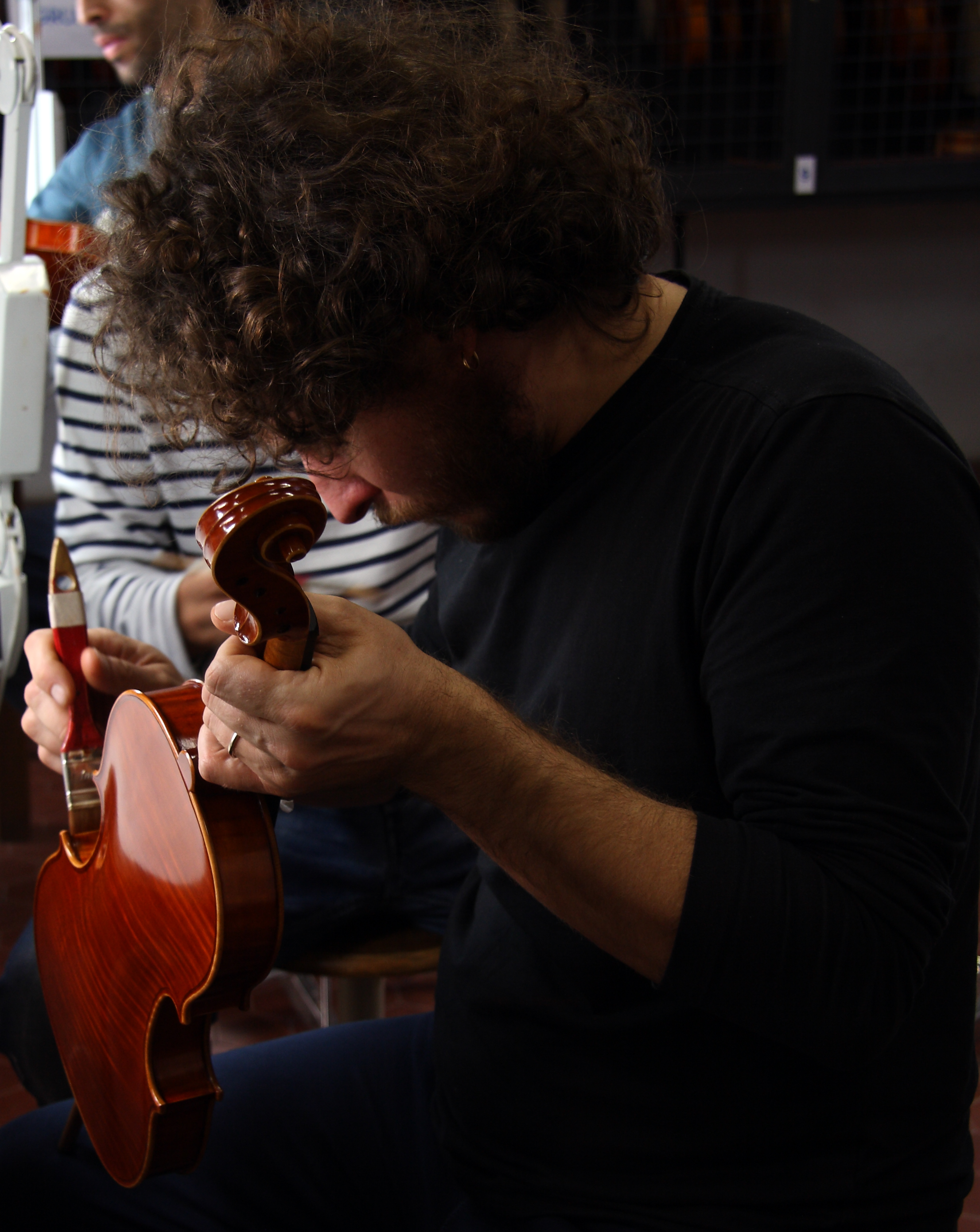
The "saper fare" of Cremonese violin making has been UNESCO intangible cultural heritage since 2012. The school passes it on as a living gesture — the master's hand transmitting knowledge to the student at the bench.
The Violin-Making District
The school works inside a dense network: Museo del Violino, the Monteverdi Conservatory, the University of Pavia (Musicology), Politecnico di Milano, the Stauffer Foundation, CrForma, the Chamber of Commerce and the luthiers' guild.
STEM & research
Non-invasive diagnostics (Arvedi lab), acoustic research (Politecnico), CT-scan and 3D visualization of historic instruments, wood and varnish science, X-ray and CAD — science standing right beside the workbench.
Training & the world
Teacher training on intangible heritage (UNESCO New Generation), international seminars, the "Going Green" project on sustainable alternatives to ebony, and exchanges with Beijing, Tolima and Poznań — with English as a bridge language.
How the school is organized.
The Innovation Project turns these principles into a concrete organization — the reason the school needs a regime of its own.
Teachers work in area équipes, so that theory and craft are designed together instead of in isolation.
Learning is organized into interdisciplinary units with clear objectives, assessment rubrics and authentic, real-world tasks.
Each workshop is capped at 10–12 students — the only way a master can follow every hand individually and safely.
A dynamic timetable and open, level-based groups let each student follow a genuinely personalized path.
Prior study and experience are recognized as credits; Italian-as-a-second-language and extra workshop hours fill the gaps.
Theory and workshop teachers share the same bench; PCTO placements and a final-year internship connect study to the profession.
The gesture as experience
In the current cycle students have built a copy of the 1793 Storioni violin from a 3D scan, restored instruments damaged by the 2023 Emilia-Romagna flood, and measured the acoustics of their own instruments. Research, restoration and making meet at the same bench — this is where intangible heritage is actually handed on.
2026 – 2031.
A five-year cycle under art. 11 of DPR 275/99, renewing an experimentation begun in 2011. The Innovation Project is the ground on which everything else — the workshops, the research, the international exchanges — becomes possible.
| Legal basis | art. 11 · DPR 275/99 |
| Cycle | Fourth · 2026–2031 |
| Previous decrees | D.M. 2011 · 2016 · 2021 |
| School | Scuola Internazionale di Liuteria |